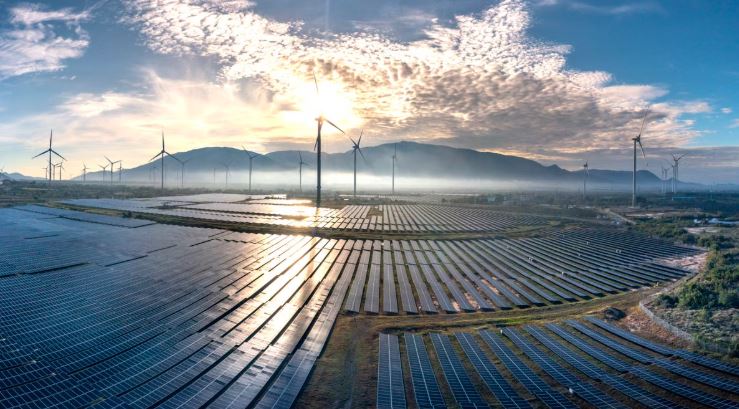
India’s rapidly expanding renewable-energy sector is creating a new investment opportunity in energy storage, with the country expected to require more than Rs 4 lakh crore of investment by FY32 to build the storage capacity needed for a cleaner and more reliable power system, according to a report.
India’s energy storage requirement is projected to rise sharply to around 411 GWh by FY32, compared with about 54 GWh of operational capacity as of June 2026. The nearly eight-fold increase reflects the growing need to store renewable power and make it available when electricity demand is high.
The expansion of solar and wind power is changing the requirements of India's electricity system. While renewable sources are adding large amounts of generation capacity, their output varies with sunlight and weather conditions. Energy storage can help bridge this gap by storing surplus electricity and supplying it during peak-demand periods.
Storage becomes the next big power-sector requirement
The government's National Electricity Plan projects a total energy storage requirement of around 73.93 GW and 411.4 GWh by 2031-32. This includes about 47.24 GW/236 GWh of battery energy storage systems and 26.69 GW/175 GWh of pumped storage capacity.
The scale of the requirement points to a substantial investment cycle for battery projects, pumped storage plants, power equipment, transmission infrastructure and related technologies.
Government estimates put the investment requirement for battery energy storage systems at around Rs 3.49 lakh crore, while pumped storage projects could require another Rs 1.29 lakh crore by 2031-32.
Renewable energy creates demand for storage
India's clean-energy expansion is one of the main factors driving the storage market.
As more solar and wind projects are connected to the grid, the power system needs greater flexibility to balance generation and consumption. Storage can help shift electricity from periods of high renewable generation to evening and night-time demand.
This makes energy storage increasingly important not only for renewable developers but also for distribution companies, industrial consumers and the wider power ecosystem.
New business opportunities across the energy value chain
The emerging storage market could create opportunities across several segments, including battery manufacturing, pumped storage development, power electronics, engineering and construction, transmission equipment and energy-management technology.
It could also encourage greater domestic manufacturing as India seeks to build supply chains for advanced batteries and other clean-energy technologies.
The government has already introduced policy and regulatory measures to encourage storage deployment. Energy storage systems have been recognised as an integral part of the power system, while measures such as competitive bidding, financing support and incentives for battery manufacturing are helping build the market.
Grid infrastructure will be equally important
Storage cannot operate in isolation. India's transmission network will also need to expand alongside renewable generation and storage capacity.
Stronger transmission infrastructure will be required to move electricity from renewable-rich regions to major consumption centres and to integrate stored power into the grid efficiently.
This creates another layer of investment opportunities for power transmission, grid equipment and infrastructure companies.
From generating more power to managing power better
The emerging energy-storage market represents a broader change in India's power sector.
The country's energy transition is no longer only about adding more solar, wind and other renewable generation. It is increasingly about storing electricity, balancing the grid and delivering reliable power when consumers need it.
For businesses, this transition could open a large new investment cycle. For the power sector, it could provide greater flexibility as renewable capacity expands. And for consumers, a stronger storage ecosystem could eventually support a more reliable and efficient electricity system.
With the requirement expected to reach around 411 GWh by FY32, energy storage is moving from an emerging technology to a major part of India's future power infrastructure — potentially creating one of the country's significant clean-energy investment opportunities over the coming years.

